June 29th, 2008

Phoresia is pleased to bring to you the first in a three-piece series about surf travel by bike. Author and traveler Scott Paynton writes about how we as individuals can make change simply by considering our daily actions.

It started off as a simple idea. My friend Mike and I wanted to go on a surf trip. Nothing strange about that! However, we have grown increasingly alarmed at how much we drive around looking for surf and the environmental impact this has. It’s been much easier to recognize the amount of gas we burn as fuel prices have now pushed $5.00 a gallon in our area. As a result of our increasing awareness and concern, Mike and I wanted to do our trip with minimal environmental impact. How close to a zero-carbon footprint could we come?

I have cycled up and down the coast many times. As I passed amazing surf day after day on my last trip, I wondered if it would be possible to tow boards and gear behind bikes. It felt like I was already carrying enough of a load just carrying gear. What would boards, board bags, and wetsuits do to the weight? I threw the idea out to Mike and he was all for it. We began to plan out all of the details of our trip, preparing to do the ride over a nine day period in May, 2008. To be honest, we were doing this trip for ourselves in a way that matched our increasing environmental conscientiousness. All we really wanted was a few days carved out of the year to bike, surf, and spend time with an old friend. All seemed perfectly simple as we began to put together the pieces for a successful trip. Then, at 4:00 a.m. on a February morning I woke up and thought, “I wonder if we can get sponsors?” I ran the idea by Mike and he was all for it. We began a letter writing campaign to environmentally friendly gear manufacturers letting them know what we were doing, why we were doing it, and asked if they would like to donate sustainable gear to help us on our journey. While having new gear is great, it was our intent and promise to use the donated gear to educate others about our environmental impacts as consumers and sports enthusiasts, and to demonstrate the alternatives that are available. To our surprise, we received sponsorships from 22 organizations! In fact, all of our surfing gear was produced using the latest in sustainable manufacturing. What we were seeing taking place was a real-world example of systems theory.

Systems theory is easily summed up with a simple definition: “The whole is greater than the sum of its parts.” Put another way, anything we do as individuals impacts others around us, as well as the environment in which we exist. Discussions about global warming are, in reality, debates about a global version of systems theory. We are becoming increasingly aware that none of us truly exist as individuals without impacting others. Many cultures have long-recognized the importance of thinking from a collectivist perspective, looking out for the good of the whole rather than pursuing the good of the individual. For those of us born and raised in cultures that value the experience of the individual, we are beginning to learn the larger consequences of trying to exist outside the scope of systems theory. What does this have to do with a bike and surf trip?

The trip began as an individual pursuit for Mike and me. Let’s face it, that’s how we’re taught to think. If we want something, we should go for it, right? Our original intention was to purchase the products we needed, pursue our own agenda, and do the trip for our own self-gratification. There seemed to be nothing wrong with this line of reasoning as it is how we have been trained to think about our lives. The old Nike motto sums it up nicely: Just Do It! Why not? Just Do It! But, what are the consequences of that approach, even for a simple bike and surf trip down the coast of California?

Golden Gate bike/surf backdrop

As we gathered sponsors for the trip, we started to realize that a much bigger reality was beginning to occur — the building of community. Those we asked for help from were not companies, but people with whom we now have a personal connection. Most remarkable about the ongoing building of community was its global nature — why should companies from England and Australia care about two guys biking and surfing down the coast of California? As the sponsorship campaign and trip planning continued, I kept coming back to one word — generosity. Going back to systems theory, each of our sponsor’s actions impacted Mike and me, and ultimately, as someone taking the time to read this article you are now being impacted in some way by the actions of people you will likely never meet. We can never fully realize the full scope of our actions. We can only hope that our actions do more positive than negative.

Even though our goal was to use this trip to educate people about living life in sustainable ways, we still felt like we needed to give something back. Mike’s dad passed away from lung cancer a year ago. The tragedy of the death of Mike’s dad was that he was not a smoker. Obviously, other environmental factors contributed to his death. More and more, the lesson and goal of our trip became evident: Everything is connected and creates a sum that is greater than each of us as individual parts. In support of our trip, over 40 people donated to the American Cancer Society to help us raise $2000.

We departed on May 15th from Fort Bragg, CA; the northern-most major town on Highway 1 in California. Our destination was Mike’s house in Santa Barbara. Our community continued to grow as we slowly worked our way down the coast. People bought us breakfast, donated their computers for us to use, gave us complimentary and discounted rooms, let us stay at their houses, did mechanical repairs on our bikes, and bought us beer. Most importantly, people simply took the time to stop and talk with us about what we were doing.

Friendly strangers
Kind strangers who bought us breakfast

They listened to our stories, and told us their stories. Even now, our community grows as people hear or read our story and respond back. Whether we see any of these people again or not, all of our little actions have combined to connect us in ways that have the potential to change lives, even in the smallest of ways. All of our little actions have created a sum that is so much more positive and productive than each of us could have ever achieved on our own.

We spent nine days on the road. Some days were more exhausting than others. We didn’t surf as much as we wanted because our schedule was tight for the amount of riding we had to do. But, we got three great surf days in, and saw so many incredible surf spots. Next time, we’re slowing the pace to allow for more surfing. Along the way, we had a ridiculous amount of fun, suffered an incredible amount of pain, and learned more than we could possibly relate to those around us. The icing on the cake for me was being able to rent a Toyota Prius to get back home to northern California. The fact that car rental companies are carrying hybrids is yet another small sign that we are moving forward in the right directions. The more each of us acts, and asks others to act, in ways that produce the least amount of damage to the environment and others, the more we will see changes like hybrids at car rental companies.

The whole is greater than the sum of its parts. Knowing that I play a small, but consequential, part in the global system makes me continue to consider the impacts of my actions before I do them. Do I really need to drive to surf when I know it probably won’t be good? Rather than complaining that surf cams make my local spot more crowded, can I appreciate that these kinds of technologies have the potential to keep me from driving around looking for surf because I can see it from my home? Is it really that hard to rely on my friend who lives right by our local break to call me after he has checked the surf before I get in the car to meet him? Every action has a consequence, no matter how small. A lot of small negative actions produce major negative impacts. A lot of small positive actions produce major positive impacts. So, the question is: How can you play your part in creating a sum we can all live with?

If you would like to learn more about our trip, support those that helped us, or donate to the American Cancer Society, visit http:/www.bikeandsurfcalifornia.com


Scott T. Paynton is a professor of Communication at Humboldt State University, with an emphasis in organizational communication. During his free time you can find him surfing at his local breaks.

Posted in contributors, definitions, environment, scott, transportation, travel | 2 Comments

June 16th, 2008

We’ve talked about the “surf collective” quite often in the last year. I sometimes wonder if there is any such thing. Surfing is mostly presented to us through the paid for media vehicles that we see in print, video, and on the web. But how representative is the sales driven mainstream media of the way we as surfers, as citizens and working stiffs, live out our surfing lives?

There probably isn’t a “surfing collective” as much as there is no American “mentality.” As a group we share one thing in common and that is riding waves. We are then fractured in our countless sub-cultures as well as political views. Class and social standing divide us even further – even within our tiny surf culture. Perhaps this is why the old DIY spirit that has been part of surf culture since the beginning is more important now than ever.

Pete Lewis - Foulweather Zine publisherI recently had the privilege to publish a short essay in a small literary publication called Foulweather. Pete Lewis, sole architect behind Foulweather, has been putting out a print zine in some form or another for some time. He is at once irreverent, introspective, and critical. In the latest volume titled The Beach, Lewis brings together writers, illustrators and activists from a wide range of backgrounds. The Beach is a celebration of the threshold between civilization and nature. It is also a critical look at the way our society has developed and perhaps devolved. But The Beach is also quite personal – looking at the way we love and play with nature and what we have to loose and gain.

We interviewed Pete because his work and his ideas play an increasingly important role in the future of our surf culture. There are others like him out there; maybe you are one - producing art, literature, music and film. People are taking up hand tools and making their own wave riding vehicles rather than buying a widget made in some far off factory. There is yet much hope in our surf culture and even in our humanity but like Stiv Wilson says in his essay in The Beach, “if we don’t activate, who will?”

Q. What’s your personal history with surfing?

Well I come from a village called Mumbles that is essentially the epicentre of surfing in Wales. That might not sound like much but most young boys I grew up with played rugby and surfed. That’s just what you did. However, just as I was about getting to the age to surf, we packed up and moved to Bahrain in the Persian Gulf. I remember asking my dad if there were waves out there and he said no. I was devastated. But I knew then, at age nine, I’d eventually surf. Instead of surfing, I spent a lot of time skateboarding and swimming. Two of the best substitutes for surfing, in my opinion. Then, whenever we’d go anywhere with waves, I’d body surf my brains out.

Finally, I moved back to Wales for University. I moved to Aberystwyth in mid-Wales on Cardigan Bay. Cardigan Bay doesn’t get much swell but when it does there are some classic boulder points and reefs that light up and it is relatively uncrowded. I spent three years reading American Literature and surfing in whatever waves I could find. After university I moved back to Mumbles and spent much of my time with menial jobs, on the dole and dialing in the Gower coastline, which was way more consistent than Cardigan Bay. Then onwards to Oregon where I’m continually humbled by the mighty North Pacific. In between, all that, I’ve had the fortune to surf in England, California, Canada, France, Spain, Mexico and Hawaii.

Because I dreamt of surfing for so long before I got the chance to physically do it my definition of surfing has always been pretty liberal. For instance, a year or so ago, I was pushing my skateboard through rush hour traffic in Manhattan New York. Straight down the middle of the road, swerving between cars and ollieing manholes. It was about as far from a Hawaiian tube as you can get but to me it was just as satisfying and tapping into the same essence, as well as fulfilling the same primal urge, as surfing does.

Q. Foulweather has an aspect of social criticism. Do you think that in our modern lives of self-indulgence we are missing something that’s irreversible?

I certainly think that by removing ourselves from nature and complicating our lives with technology we’ve lost a lot. From what I understand, a growing number of psychologists are concerned that our increasing isolation from nature is having a devastating impact on our collective mental health. Not only that but some are suggesting we might be suffering collective Post Traumatic Stress Disorder as a result of what we’ve done to the planet. You used the term, irreversible, which I think is apt because, obviously we can’t put the genie back in the bottle unless we take drastic action or something drastic is thrust upon us, which is perhaps inevitable. Technology and science can’t be unlearned, but if they’re not we’re just going to continue to be locked in this vicious cycle of trying to further science and technology to combat the ills it has already thrown upon us. Or as Miki Dora said, “Until that very hour the bourgeoisie must be reconciled to their customary Orwellian entanglements, rushing to be saved by technology… and then saved from it.”

Q. The Beach covers a broad range of subjects and the authors/ surfers come from diverse backgrounds. I wonder what this says about the surfing collective? Do you think that there is such a thing as a surf culture/mindset that exists outside of the mainstream? And do we as a group have any responsibilities to the culture?

Well, for a long time, I was sceptical that modern surf ‘culture’ had much to offer. I was predominantly a skateboarder, and was blinded by the anti-authoritarian, DIY attitude of skateboarding. I though street skating offered a profound critique of the modern city, a redefinition of public space away from consumerism and commerce. I didn’t think that surfing had a similar critique. But I started reading more about surf history and surf culture and realized its profound role in the history of drop-out and youth subcultures. Eventually, I began to understand surfing as a metaphor for paradise lost mainly as a result of my fascination with Miki Dora and post War Southern California. That’s where I got the idea for the theme The Beach. The latest issue of Foulweather is basically my crude attempt at a socio-political history of The Beach as symbol of liberation and it was obvious to me that surfing played a central role in it. What ‘responsibilities’ do we have? I’m not sure surfers should accept any responsibility but we should be stewards of the ocean and the coast. And we should be an inspiration for people to prioritize getting off the computer and immerse them selves in nature. However, surf culture can be pretty hedonistic, self-indulgent and entitled, so I’m not sure many of us are qualified for those responsibilities.

Q. We’re big fans of the DIY spirit and it’s traditionally been a characteristic of surf and skateboard culture. You’ve been self publishing for a while and you promote unheard of writers – all with your own cash. Why do you do it? And do you think that the DIY spirit is dying?

I do it for me. I do it because, I’ve been writing since I was fifteen and never knew what the hell to do with my stuff. Essentially, I did it because sometimes it is better to make something happen yourself rather than wait for something to fall on your lap. But it wasn’t until I moved to Portland Oregon that I understood how possible it could be. I was really taken aback by how many writers, artists, musicians and so on, did things themselves. Created their own scenes, put out their own zines without a care about how they’d be accepted by the wider world. In this current age of mass communication, ease of travel and global interconnectedness, it is hard to shine as an artist. Perhaps, in a more ideal world, where ‘community’ actually meant something, artists would have an easy time proving their worth to the fifty or so people they are ‘tangibly’ connected to. In other words, I think the essence of DIY as being primarily responsible to your immediate community. Dischord Records out of Washington DC are a perfect example of this.

At the same, time, as I mentioned earlier, we can’t put the technological genie back in the bottle at this point and Foulweather has reached a wider community and as much as I have some concerns with ‘virtual community’ it has been a useful tool for connecting with people such as yourself.

I don’t necessarily think the DIY spirit is dying. I do worry that we are becoming increasingly specialized in our skill sets and that less and less people know where to begin when it comes to embarking on a DIY project. At the same time, as is evident from the abundance of blogs, the desire is still there to create, document and promote vital subcultures and scenes.

Q. In the Diamond Mining with Dora piece you talk about mans’ separation from nature and the subsequent repression of our primal urges. I think at Phoresia we tend to be optimistic about the future but sometimes it’s hard when we see the speed at which humanity consumes. What’s your view of the future for the way we will live and play?

I’m not qualified to comment on where we are heading but I tend to agree with Derrick Jensen that the sooner civilization crumbles the sooner the planet can recover. It might sound a bit radical but I really don’t see how we can continue being so globally interconnected and interdependent. The only hope I have for the future is if, people could eventually get back to a point they can get everything they need for survival and pleasure within walking distance of where they live. I don’t really see how more technology or more science can help us if we don’t have a healthy land base to live off. Until then I suppose we’ll just plod along with ‘band-aid’ solutions such as recycling and bio-diesel. That’s not to say we should abandon hope or daily efforts to live a more eco-conscious lifestyles.

Q. You chose a printing company that operates using a sustainable business model of their own design. The journal is printed on recycled paper with veggie inks. What is your definition of sustainability?

Again it’s a band-aid solution. If I’m going to use up resources to print a zine, I may as well try and limit my impact. I don’t think printing a zine is sustainable at all no matter how ‘eco-friendly’ we pretend the process is. Sitting around a fire with a few friends telling a story would be the only sustainable way of doing what I do with Foulweather but like everyone else, I’m willing to make huge compromises to get by in this modern world or I’d go insane. And, when I consider all the junk mail I get, I don’t feel too bad about printing a zine and hopefully, Foulweather inspires someone somewhere in one way or another.

Q. You’re well traveled. What’s your take on surf tourism and how it affects local cultures?

I was actually thinking about my travels the other day. Generally speaking, I’m quite lazy. Most of my travel opportunities have been thrust upon me. Due to being raised as an expatriate, I have certainly seen a few places and usually when I go somewhere I will take a surfboard or skateboard.

I will say that whenever I’ve surfed somewhere like Hawaii or Mexico, I always have the most fun, surfing with the locals. It is the tourists like myself that can make surf travel unpleasant. Again, it goes back to the sense of entitlement and hedonism in the culture. ‘I paid for this, I deserve my waves.’ In Hawaii, I found that a bit of humility, smile or nod, would go along way with the locals. I’m not into competing for waves. So when I’m somewhere new, I sit wide of the peak and wait until I feel I’m not intruding or wait for an invite to surf. I don’t always get many waves this way but it has resulted in some of the best waves of my life. As soon as it becomes a competition, I’m done. I don’t surf well or enjoy it. I’ll surf the mushier peak down the beach thanks, or better yet, I’ll go skateboarding with some friends.

In general, I think travel can be way overrated. Some of the most profound people I’ve met have barely left the town they are from and I’ve met some complete ignoramuses who’ve seen the world. I’m not interested in getting a Starbucks in Shanghai or eating MacDonald’s in Dubai. I am interested in what books my neighbour reads and why even though we both obviously like Black Flag we’ve never shared a cup of tea or a pint of beer.

Q. Will you always surf?

To me, surfing is the ultimate form of leisure. I can’t quite verbalize it and I probably shouldn’t but surfing makes me feel human. There is a scene in Terrence Mallick’s “The Thin Red Line” where an American GI goes AWOL in WWII. He is living on an island near the South Pacific, away from the chaos of war, swimming with naked children, living off the sea and land. That’s where I go when I surf.

I’m pretty much a lost cause. I obsess over it. Forecasting, board specs, improving my cutback, it all often consumes me. Sometimes, I feel so shallow because of my surf/ skate obsession and have to make a conscious effort to widen my interests/ experiences. I’m currently saving sick time in case an elusive Southern hemisphere swell makes it up to Oregon this summer.

Q. Last words?

Thanks for giving me this opportunity, I’m not sure I’m worthy of this interview but I respect what you are doing with Phoresia and your criticisms and celebrations of surf culture and the surf industry. Support your local shapers, surf shops, farmers, coffee roasters, beer brewers, zine makers, ha ha. Seriously though, consider how and why you consume and travel wisely. Unplug and go outside for a bit.

I’m about to lock myself in a metal box, drive 70 miles spewing up god knows how much carbon monoxide for a few waves…


You can read Pete’s Foulweather blog here. You can also order a copy of The Beach from Pete’s site or from Powell’s Books.

Posted in art, diy, interviews, phoresia.org | 9 Comments

June 9th, 2008

When it comes to making sure our playground is safe and accessible there is one organization that stands heads and shoulders above the rest as far as dedication and perseverance to the cause. The Surfrider Foundation has been around since 1984, getting involved and trying to ensure the protection and enjoyment of the world’s oceans, waves, and beaches for all people, through conservation, activism, research and education. We dropped Surfrider CEO Jim Moriarty a few questions to get his take on a few different subjects and to find out what the biggest hurdles are that Surfrider faces. Grab a cup of coffee and check out what he had to say -

Q. Please tell us a little about yourself and your surfing life. How did you get involved with the Surfrider Foundation?

Jim Moriarty - CEO Surfrider FoundationI was weaned on punk rock, skateboarding and snowboarding. I took up surfing in my twenties and never looked back. Today, I categorize myself as a surfer above most other categories. A few years ago I was recruited to the Surfrider Foundation. I’d been a fan and supporter for years but was living and working in the technology sector. Initially I didn’t think I was the right person for this job, but after some extended dating the board convinced me otherwise. They were right and I was wrong, I’m home.

Q: Your Ocean Waves Beaches blog is an extremely focused outlet for getting the word out on what Surfrider is about - not just specific issues but bigger overall ideals. How has the feedback on the blog been both internally and from the public?

I would characterize the feedback on my blog as -hesitantly optimistic. What I mean by that is the Surfrider Foundation culture and I might argue is that the activist/environmental culture in general is still getting their collective head around internet communication vehicles. A large percent of the reason I’ve created blogs, wikis, podcasts and vodcasts is to show people what is out there what is possible what tools exist. I know that the second wave of users and creators will take these and other new tools and do insane things with them. I’m an instigator in this sense and that is very intentional. So it’s not about whether my personal blog is relevant or not, but rather if our collective messaging on the Internet is. I want to simply push people out into new spaces and have Surfrider Foundation’s mission and influence create new on-ramps for people.

Q: You talk repeatedly about “on-ramps” on your blog. At some point for people to get involved they have to connect with some issue, however big or small, that they can identify with and be passionate about. What do you feel is the biggest hurdle in getting people involved, not only with Surfrider but conservation in general?

Historically, the biggest hurdle in getting people involved was Green’s self-congratulatory and exclusionary mindset. Green was a club and they really weren’t looking to attract new members. Anything that discounts a large portion of the population is destined to be small and irrelevant. I think that hurdle has shifted with the current trends of the green movement. Surfrider FoundationToday, the largest hurdle is giving each person on the planet an on-ramp that fits. We need to give everyone a way to plug in that is tailored to his or her interests. For example, if a person is really into digital photography, then they probably won’t plug into our legal issues team. Instead, they need a digital photography onramp. THEN, after they’ve come on, they will become educated on issues beyond their initial interest are, and the impact will be much larger than digital photography. This concept and the challenge behind figuring out how to transition someone’s love into a larger movement, is one of the things that keeps me awake night after night.

Q. As an activist, do you see degradation moving faster than conservation? Do you think that as a society we’ll be able to slow our pace of development enough to possibly reverse some of the damage that has been done?

Short answer, yes. Longer answer, the world has changed radically in the past fifteen years and most of its inhabitants haven’t seen or understood the ramifications of the changes. As a result, they haven’t changed their habits. Friedman’s “The World is Flat” summarizes many of these changes - until America collectively understands they’re not the only ones with their hands on the steering wheel, we’re heading towards a cliff. China just surpassed America with internet usage (we have 75% of our population online and they have just 12%). Having China and India join the U.S. at our level of consumption calls for five planets of natural resources (thus the shifts in commodity prices we’re seeing globally). These three countries must change course or we may be toast. This reality points to why I am a fan of the developments characterized in Krupp’s recent “Earth: the Sequel.”

Q. What’s your take on the burgeoning environmentally friendly surfboard market? Do you think that people around you are taking note and looking for equipment that’s intentionally less polluting?

I think the environmentally friendly market for everything is in the nascent stage of its development, thus we’re living through the awkward years right now. That said I love it. Looking specifically at the surfboard market - I love that Danny Hess is not only making insane, workable quads, but even more is that Dan Malloy is on the cover of Surfer’s Journal absolutely ripping on one. That’s a key piece of the equation… people need to see that new technologies, in this case greener boards, work. But they need to see them doing more than working, they need to see them ripping. Another angle into this is that a green board isn’t simply equipment that’s made from natural products but also boards that last a long, long time. Shane Dorian rips on a Surftech, so it’s validated as ripable. But it’s more than that, a high school buddy ran over a Surftech in his truck with all four wheels and the board was fine. Sometimes the answer isn’t as obvious as it might seem.

Q. One aspect that often is not addressed in environmental activism is our consumer lifestyle and how that affects our ecosystem. Let me be clear. I don’t mean to say that we should not consume, I understand that it’s in our nature as humans. What I am referring to is our culture of over consumption or conspicuous consumption. Do you think that it’s just too close to home for people, that we feel entitled to purchase anything and everything because we worked for it? Do you see a possibility of a cultural shift to a simpler life?

Yes, I do see the possibility of a cultural shift to a simpler lifestyle. To be frank, I don’t see that with most people over a certain age, as they seem to find such changes quite hard. They also lived most of their life with a -more is more- mentality: a house as the American dream, and a second house as a better dream than that, etc. We’ve all seen this when we talk about global warming with someone over a certain age.

Jim Moriarty - CEO Surfrider Foundation
Photo: Steve Sherman

It’s very, very hard for them to grasp the fact that their collective choices (as well as my choices) created something so potentially horrific. This isn’t age discrimination, its just habits built over time. I’m 45 and I see this in myself and with my friends. Lifestyle changes simply seem to be harder as people age. The flipside is the cultural movement work that people like Jack Johnson are doing. My kids… everyone’s kids… know the words to his 3R song; reduce, reuse, recycle. The wave of awareness and consciousness regarding the environment with youth is massive. It’s a tsunami. I’m betting on those youths and non-youths that think youthfully to drive many of these shifts.

Q. What’s your take on the fashion industry built around surfing? It’s clear that some of the companies donate towards environmental causes but overall what influence do you think the fashion industry has on surf culture?

In my opinion, surf culture in many ways reflects what we see created by surf retailers. I say this because I see a large cross section of people that surf in my day-to-day life and much of the time their lifestyle and self-awareness is an extension of the surf brands they wear. Of course it’s not this simple, there are fragments of surf culture that represent many sub-groups. I happen to personally really identify with all things Sprout, Andy Davis, fish-culture, etc. I’ve always been into the artist splinter of surf culture but I know there are hot-rod and old-guys-rule veins in surf culture, as well as the zillions of international mixes of various flavors of surf culture. Still, put all that together on a massive white space and you’ll see some dominant form. I’d argue those reflect what we collectively think of when we think of the surf industry. I’d also add that there are leaders and companies that have been dialed into environmental support and themes for decades, Paul Naude at Billabong and Yvon Chouinard at Patagonia come to mind.

Q: In your position, you probably have a better overall global view of the problems affecting surfers such as access, water quality, and pollution than most people in the industry. What do you see as the biggest threats facing surfers both today and in the foreseeable future?

Apathy. No question in my mind. Surfrider Foundation is global; we have 80 entities around the world. A majority of those entities and activists that are driving campaigns aren’t surfers but rather incredibly aware, driven beach enthusiasts. We need more surfers involved. The writing is on the wall; beaches are being lost, beach access is being lost, waves are being lost, water quality is being lost. Read this list of recent victories, then go to this list of chapters to find a way to plug in.

Q. What does sustainability mean to you?

Sustainability means that an action can be done in indefinitely.

Q. Any last words of wisdom?

Life can seem complex but it’s not. Take a step back and see cultural inanity for what it is… turn your TV off; take up an instrument, do something new. Lastly, know what you love and then put yourself into that thing. For those of us involved with the Surfrider Foundation that thing is oceans, waves and beaches. We love those. Whatever you love, act to protect it, act to make it flourish. Act.


Find out more about Surfrider and find a local chapter near you and get involved - www.surfrider.org

Check out Jim’s blog over at oceanswavesbeaches.blogspot.com/

Listen to some interesting dialogue on the Podcasts at www.surfrider.org/media4.asp

Posted in environment, industry, interviews | 1 Comment

May 26th, 2008

I’ve got a board rack in my garage that holds 6 boards. I figured that’s plenty of space, 6 boards should cover a solid range and would be considered a pretty solid quiver. Over time I’m amassing more and more boards, finally the past few weeks after having 3 boards in bags piled up on the floor I told myself it’s time. That dreaded day when you gotta tell some of the kids it’s time to go. Ass, grass or gas, no one rides for free. So I pulled all the trusty steeds out of storage and laid them out for the ubiquitous “quiver shot” -

Lawless’ Quiver shot

Originally my intent behind doing this was to re-evaluate myself. Apply some introspection and practice what I preached by being self-critical and coming to terms with the fact that, besides my best intentions, my quiver had sprawled like modern day suburbia. It was time to reign it in. What happened next kind of surprised me. After looking at all my boards sprawled out in the grass, I realized something, something we try and re-iterate time and time again here on Phoresia but I hadn’t really come to terms with the practical implications of it until today. Durability.

The reason my quiver had outgrown it’s intended storage space was due in part to durability. By getting my boards glassed a little stronger and by using some alternative construction my boards were lasting much longer. So instead of replacing a board that was worn out I was ordering new ones with different variations, or in the case of the Bonzer, something totally new to me. Durability had allowed me to experiment and try new things versus just replacing what had worn out prematurely.

The picture above is kind of deceiving because there are actually 2 sets of boards there that are somewhat redundant. There are two 6′4″s, one 6/6/6 poly and the other a stringerless EPS/epoxy. There are two of the exact same 6′0″ rocketfishes, one in Biofoam that’s a quad and one that’s EPS/epoxy that’s a thruster. The EPS/epoxy board is nearly 3 years old and has been abused to hell and is still holding up great. That durability allowed me to order another similar board but in different material and a different fin setup to be able to compare apples to apples somewhat. In my experience, this has been the best way to test out new materials. Have a baseline setup to compare to then change a few variables at a time, in this case blank material and fin setup. Again the durability of these boards will allow me to recycle them back into the local shop as trade-ins or post them on a site like ReRip.com.

The durability aspect really has quite a few added benefits for the average surfboard. Not only are you getting more useful life from the board, you are less likely to snap or ding the board and also it keeps the materials out of the trash and in the water for a longer time. This allows you to get new boards instead of just buying boards to replace worn out ones, or to sell your used board that still has useful life in it.

So after much deliberation, none of the kids are getting kicked to the curb just yet. The single fin is actually the board Ricardo was riding the first time we met while we were both out surfing. I was digging on the board and asked him to ride it. It was given to me on permanent loan a few years back so needless to say, it’s always got a place in the racks. The mini-gun gets used maybe a handful of times each year, but those days it’s a necessity and I’ve had that board for almost 10 years now and have the utmost confidence in it. Key in a big-wave board. Rack space #2 filled. The 5′ 10″ quad is my summer board and has paid it’s dues as well. I’m hoping to re-create it as a hollow wooden board this summer if time permits. I’ve already got it made up in AKU shaper, just need to print the ribs and stringer.

The 6′0″ rocketfishes are kind of redundant and could be paired down to one board, but the new job I start next week has flex-time and is only 1.5 miles from the beach, so I may keep one at the office so if I ride my bike to work I’ve always got a board there. The 6′2″ Bonzer may just be my new favorite board, but I haven’t had enough sessions on it to really feel it out. It could take the place of my 6′4″ as my good wave board. I can probably get rid of the yellow 6′4″ now, it’s served it’s purpose well with sessions in Costa, Hawaii, and Australia. It’s got that late 90’s entry rocker though and I wanted something with more early entry ability and am pretty stoked on the new 6′4″ stringerless board. So really, after deliberating about the quiver, there’s only one board that can go, the old 6′4″. I may just keep it though and put straps on it for kiteboarding, who knows. Better to retro-fit it than get a new board.

All in all I’m pretty stoked on the quiver at this point and have been happy with the durability of the various boards and the myriad of different construction techniques. I feel like I’ve got all my boards dialed in to where it’s my own abilities that are holding me back and not the boards. The best part is most of them are a few years old and will easily give me a few more years of quality shred-sledding.

Moral of the story? It’s good to pull out the complete quiver now and again and give it a good critical evaluation. In thinking of new boards to fill the voids, also think of what materials you could use to make those boards last longer while still serving their intended purpose. Poly has it’s place as well as epoxy and wood. They can all be made to be extremely durable, it’s just up to us at the consumer to require them to be built that way. In the end you’ll be glad you did.


For those who will inevitably ask for dimensions, here’s the specs on all the boards in the picture:
left to right:
Neilson 5′10″ x 21 x 2 3/8 quad (poly)
Neilson 6′0″ x 19 3/4 x 2 1/4 rocketfish quad (Biofoam,epoxy)
Neilson 6′0″ x 19 3/4 x 2 1/8 rocketfish (eps/epoxy)
Neilson 6′2″ x 19 1/4 x 2 1/4 Bonzer (Ice Nine,poly)
MTB 6′3 x 20ish x 3 singlefin (poly)
Neilson 6′4″ x 18 3/4 x 2 1/4 (poly)
Neilson 6′4″ x 19 x 2 1/4 (stringerless EPS)
Lightwave 6′10″ x 18 3/4 x 2 3/8″ (poly)

Posted in board construction, phoresia.org | 2 Comments

May 19th, 2008

Surfing is a physical activity that for the most part cannot be made easier with purchase power. What I mean by that is that if you have a board that has enough volume to float you proper, and is constructed in at least a decent manner, the rest is up to fitness level and experience. Other sports, like mountain biking for example, can be easier to achieve a level of performance based on how much money one spends.

In mountain biking there is a huge range of equipment. You could get a steel single speed mountain bike with no suspension starting somewhere around $500. Full supsension ridiculousnessOr you could spend $5000 on a full suspension mountain bike made from fancy carbon composites. Both bikes are purpose built for riding single-track, as the trails are called. For a novice, or someone who only rides once in a while, the full suspension will allow him/her to ride faster and safer on rough terrain than the rigid single speed. This is because the full suspension bike affords the rider the ability to make mistakes in choosing lines as it absorbs the bumps from roots and rocks. But on the rigid single speed the rider is forced to pedal harder and pick the cleanest line in order to avoid bone-jarring impacts from the same roots and rocks and to maintain momentum.

Essentially, the price of entry into the sport is relative to actual dollars spent. Although it must be said that skill, built over time, can overcome the gear. There are plenty of examples of racers winning gruelling mountain bike races on rigid single speeds, outdoing the rest of the field, many of which sit atop several thousand dollar full suspension bikes. But this is not the case in surfing, in which the ocean is the ultimate teacher in humility.

Paddling prowess - bad man stylieMy initial inspiration to write this piece was as an ode to paddling. I love paddling, much like how I love pedaling my bike. But it wasn’t always that way. I used to obsess over my board – was it the right shape, too big, too small, the fins, the colour, traction pads? Then as time went on and I got to observe others I realized that it was paddling ability that separated the rippers from the schralpers. And not just paddling fitness, but knowing where to be on the wave, how to paddle into the peak, how to duck dive, especially in nasty beach breaks, this was the key to surfing better. I remember one day early in my surfing days, my friend Francis and I were sitting on the beach after a two-hour session on our longboards. We were laughing at a guy that walked past us wearing too short board shorts, a nasty long moustache and a bloated 80’s thruster - mind you this was in the mid 90’s before the 80’s were hip again. The guy proceed to rip, getting so much speed on the thigh high day that it seemed like had something we didn’t. And indeed he did, he had experience and paddling power.

So when I start thinking about new surf gear I try to remind myself that the gear won’t make me surf better. The only thing that will help improve my surfing is time in the water and a strong stroke. We are inundated every day by advertising telling us that if we acquire this thing and that thing our life will be markedly better. It’s bullshit. Going surfing, being out in the elements, riding energy as it moves through time, feeling the ache in my shoulders from a long session, these are the “things” will make life and my surfing better.

Posted in phoresia.org | 8 Comments

May 13th, 2008

I opened up my email early this morning to find a message from Australia about a new publication called Kurungabaa. The email was short but direct. It’s main purpose? To introduce Kurungabaa, a “journal of literature, history and ideas for surfers.” I replied that I would take a look and went on about my morning rituals.

australian pelicansThroughout the course of the day I read several of the sample entries, stealing time at work in between email and paper shuffling. At the moment I am moved infinitely by some of the thoughts I came across. I feel like anything I may say about the publication will be too little, as my own abilities to pound on these keys and get a clear point across in a way that contains both style and integrity is still eons away, if it ever reaches me at all. But what passes across my vision on the online version of the freshman text is anything but amateur.

The journal’s editorial mandate is to provide a platform for commercial free content, produced by established as well as rising surfer authors, poets, artists and of course photographers. The first issue has a fiery introduction written by Tim Baker in which he challenges surf magazine editors worldwide to have some integrity in a time when editorial content is strictly driven by advertising dollars. But it’s not all serious business here. There is humour by the bundle. Being new to Aussie surf writing, I was surprised and fully inspired by the looseness and freedom with which writer DC Green expresses himself. And there’s still a tone I’ve yet to read! Please be sure to visit the site for more information. And if you are a writer check out the contributor section.

We can be certain that the surfing collective is not sitting on its laurels these days. As surfers we can purchase locally made boards made from more earth friendly materials, we can get non-petrol based surf wax, and even high quality, commercial free surf writing. It’s a good time to live simple and pursue a life of surf, even if we are in the midst of rampant consumerism. Give Kurungabaa a read, get stoked, go surf.

Posted in art, news & media, phoresia.org | No Comments

May 5th, 2008

So we’ve been slacking a bit on content lately, but not without good reason. The biggest reason being the birth of my baby girl last week. All is good and we are stoked on the latest addition to the quiver.

Little girl
Dims: 19.5″ x 7 lb. 14 oz.
Definitely a “small-wave” model, notice the adjustable, accelerated tail rocker. Unique design feature.

Another factor in the lowered post count has been the unusually consistent surf we’ve been having on the East Coast and on top of that a couple new boards to try out -one being the Bonzer in the post below, and the other being a stringer-less EPS/epoxy board which we’ll be doing a write-up on in the near future. Ricardo has a Biofoam Bonzer that should be at his door any day now for the nice points up in the Maritimes. I got a sick new hemp boardbag and recycled leash from WaveTribe, so look for a write-up on those coming soon as well.

There are lot of new products out there that are less harmful to the environment, which seems to point to the fact that the “going green” movement has reached a tipping point now where it is passing over into mainstream business. You now when there are surf industry business seminars for going green, that producing less harmful product has hit the manufacturers where it counts, in their bottom line. Companies realize it’s a growing market and people are demanding greener product and if they can’t deliver, someone else can. Again, to re-iterate our often repeated message, support the companies that support the environment. It will only help to push other companies to re-evaluate their positions or risk losing market share.

Most of the green washing seems to be going down on the softgoods side of things, whereas the place where it counts, the reason why we live our lives the way we do, is seeing some real tangible improvements. I’ve been using some soy-based wax from Magma that’s been working killer and also heard some rumors about some track pads sourced from more friendly materials. Just a couple more pieces in the pie toward having a complete setup that is just that much less harmful to our surroundings.

Summertime is just around the corner, so with the lack of waves, hopefully we’ll have a bit more time to get focused back on Phoresia. In the meantime, we’ll be out surfing and cruisin around on our bikes.

Posted in board construction, industry, phoresia.org | 13 Comments

April 21st, 2008

I’ve had my Ice Nine Bonzer for a couple months now but we had a stretch of terrible waves. And then we got one of the best swells we’ve had all year and the night before my shaper dropped off a new stringerless EPS board that I’ve been waiting on for quite a while. So sadly the Bonzer has been sitting neglected in the racks without its fins even being installed and no wax.

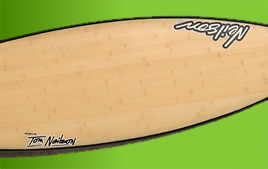
Neilson 6′2″ Bonzer

Needless to say, the constant barrage of Bonzer-porn that gets posted over at SurfySurfy really had me wanting to try one out for myself to see what they are all about. I’ve wanted to get a Bonzer for quite a few years now, but have been trying to get my quiver dialed in so I never had all my boards perfect where I had room to experiment. I was always refining and updating shapes, trying to get all my boards to work well in the wave conditions they were intended for. Then several moths ago we received a couple of plant-based Ice Nine blanks to try out for Phoresia and figured a Bonzer would be a perfect experiment for one of the blanks. I picked the brain of my long-time shaper, Tom Neilson, and finally settled on a 6′2″ round-tail outline that he already had pretty diealed and had good feedback on from his team riders.

The Ice Nine blank shaped up well but there were some issues with the glassing. Ice Nice has the process dialed in but it requires following a rigid set of instructions to prevent overheating the blank during the glassing process. This board was airbrushed solid yellow as well, so there could have possibly been a reaction with the paint, but the end result left air bubbles in the glassjob. The flaws were mostly cosmetic but not something that could pass off in a retail environment. I wanted to ride the board a couple times before I gave a solid review of it to see if there would be any problems aside from the aesthetics.

Well I finally got the first sessions in on it this past weekend. To make a long story short, I was blown away. Friday after work I took the Bonzer out in some head-high junky beachbreak. Right away I could tell I was going to like it. It paddled how one of my favorite small wave boards paddled and just felt connected. The first wave I took off on I had no idea what to expect and was pleasantly suprised by the speed and looseness of the board. I guess I had preconceived notions of it riding more like a single than a thruster but it’s a unique feel all it’s own. Loose but not like it’s going to slide out, it felt engaged but went rail to rail quickly and easily. With so much new design going on under my feet it was hard to tell what was contributing to the overall ride but I had a great session, caught a ton of waves, and was feeling really confident on the board. Not much more you can ask for out of a board on the first go out.

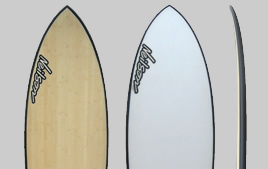
Neilson 6′2 Bonzer Deck/BottomSaturday morning the waves had dropped in size a bit but it was clean with a full tide. I took it out again to see how it would work in smaller surf that required a bit more effort to produce speed. Again, pleasantly surprised. I made some really fast little sections and it felt good on waist high bowly waves. All in all I’m super stoked on the combination. After two sessions I’ve got a minor heel dent from my front foot, but that’s it. No other pressure dents which is surprising considering the abuse I dished out to the board on Friday’s shore pound session.

The feedback on these blanks has been similar to that of the Biofoam boards. They tend to hold up better to compression dents and can be glassed a little lighter than an average poly board. The board is glassed with 6/6 oz. on the deck and 6 oz. bottom and poly UV resin. With the five fin boxes it’s no lightweight but I don’t mind trading a little weight for the added durability.

As far as the Ice Nine blank goes, it’s a viable alternative, but it does require some added attention during the glassing process. I’ll have to wait and see how the longterm durability is to make up my mind about it. It’s interesting though that in the past month I’ve ridden boards made of standard poly, biofoam/epoxy, IceNine/UV poly, EPS/epoxy, and a stringerless EPS/epoxy board. All were locally shaped and glassed. The alternatives in materials are definitely out there if you are willing to search them out and ask for them. Try it, you just may like it.

Posted in board construction, industry | 5 Comments

Navigation

Archives

Meta